Old West prairie schooners
By western author Nick Brumby
“On all the prairie the white-covered wagon was the only sign of human life. It was visible as far as a sail would have been upon the lake, and the prairie, with its graceful undulations that had once been its bottom, waving now with grass, was not unlike the water’s surface. A “prairie schooner” was what the settlers called such a wagon.” — William Eleazar Barton in ‘The Prairie Schooner: A Story of the Black Hawk War’
 It’s fair to say that the Old West was born in the back of a prairie schooner.
These versatile wagons carried uncounted millions of migrants from Ohio, Illinois, Kentucky, and Tennessee, looking for the land of plenty in Oregon that they had heard about.
A prairie schooner, (or covered wagon) is a horse, mule, or oxen-drawn vehicle made from a wooden floor with arched wooden bows supporting a stretched canvas cover riding on iron-plated wooden wheels. Covered wagons became the most popular means for transporting pioneers and their belongings to the Western United States in the 19th century.
Between 1840 and 1860, roughly 350,000 settlers rolled west in these canvas-topped wagons. Each one crawled along at about 15 miles a day, following trails that would later become major highways. The name came from that billowing canvas bonnet—it looked like a ship’s sail skimming across the plains.
 Covered wagons were most widely used to transport the worldly goods taken by pioneer families as they travelled westward to build a new life. Prairie schooners carried food, supplies to maintain the wagon, cooking supplies, bedding, clothing, and keepsakes.
What pioneer families packed could mean the difference between life and death on the trail and varied wildly depending upon the experience (and common sense) of the travelers. James Miller’s 1848 diary entry describes what they packed for food: “We had… 200 lbs. flour for each person, 100 lbs. bacon, corn meal, dried apples and peaches, beans, salt, pepper, rice, tea, coffee, sugar, and many smaller articles for such a trip.” Pioneers also commonly packed 80 lbs. lard, 20 lbs. sugar, 10 lbs. each of coffee and salt per person, yeast, hardtack and crackers.
 Standing 7-8 feet tall and 10-15 feet long, prairie schooners were symbols of freedom. They were the vehicle that would carry the pioneers across the rugged terrain on their way to the building of America; and they had to be as tough as the pioneers who drove them.
The wagon wheels were made of hickory or oak and had rims of iron. The wagons had no brakes or springs, so pioneers tied chains around the rear wheels to lock them or provide a drag whenever they had to go down steep hills.
Cotton canvas stretched over the bows (which were usually made of hickory) formed the weather cover. The owners could unfasten the top to cool the inside of the wagon or tie it down to shield themselves during inclement weather. The cotton canvas cover was of a double thickness, and the bonnet was often cantilevered out from the front and rear of the wagon bed for better protection of the interior during storms. The sides of the wagons were waterproofed with tar, so they could ford rivers and keep the cargo dry. A thoroughly water-proofed wagon would also float in high water, making the crossing much easier.
 The use of metal was kept to a minimum to keep the weight down. Travelers usually hung a grease bucket from the rear axl.
While Conestoga wagons could carry as much as six tons, prairie schooners were designed to be light and fast by pioneer standards. The bed of the Western wagon was made of wood with approximate dimensions of 4 feet wide by 6 feet long with a built-in toolbox in the front.
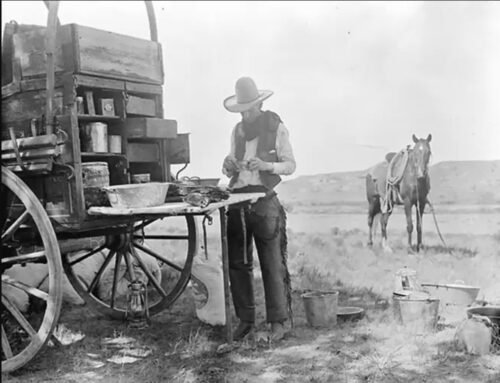
Most wagons also had a “chuck box” at the back of the wagon that consisted of a fold-down table surface in front of a cabinet that contained food, utensils, plates and basics needed to prepare a meal. Shelving below the axle contained larger Dutch ovens, bowls for making bread dough, tubs for washing, or even bottles of a more sundry nature.
 Medical and surgical supplies were essential: bandages, ointment, laudanum, cough syrups that contained cocaine, painkillers that contained opium, and of course alcohol for drinking. Surgical instruments for suturing wounds, pulling teeth, lancing boils, extracting bullets or arrowheads, and a bone saw for amputating were commonly packed as well.
When they had the choice, pioneers usually chose oxen over horses for pulling prairie schooners. Oxen were slower but could pull heavy loads on prairie grass and water, unlike horses. Oxen could haul 2,500 pounds day after day, eating whatever grass they found and drinking from streams. Horses needed grain, were faster—but also panicked easily and wore out quickly. Pioneer diaries from the 1850s mention families walking 2,000 miles in 200 days, averaging just 10 miles daily when the weather turned nasty.
 Most wagon trains had at least 25 wagons. Perhaps the largest wagon train to travel on the Oregon Trail left Missouri in 1843 with over 100 wagons, 1,000 men, women and children, and 5,000 head of oxen and cattle. The train was led by a Methodist missionary named Dr. Elijah White. But wagon trains became so common on the trail that processions seemed to have no beginning or end. Diaries told of hundreds of wagons passing by Fort Laramie in a single day in the 1850s.

About Nick Brumby
I like a good story. And of all stories, I love westerns the most.
As a kid, I spent far too many afternoons re-watching Clint Eastwood spaghetti westerns, picking up ‘Shane’ for just one more read, or saddling up beside Ben Cartwright when ‘Bonanza’ was on TV each afternoon.
I’m a former journalist and I love horses, dogs, and the occasional bourbon whiskey. I live with my wife, daughter and our ever-slumbering hound in a 1800’s-era gold mining town – our house is right on top of the last working gold mine in the area. There may not be much gold left, but there’s history wherever you look.
I hope you enjoy my westerns as much as I enjoyed writing them!
Happy trails,
Nick